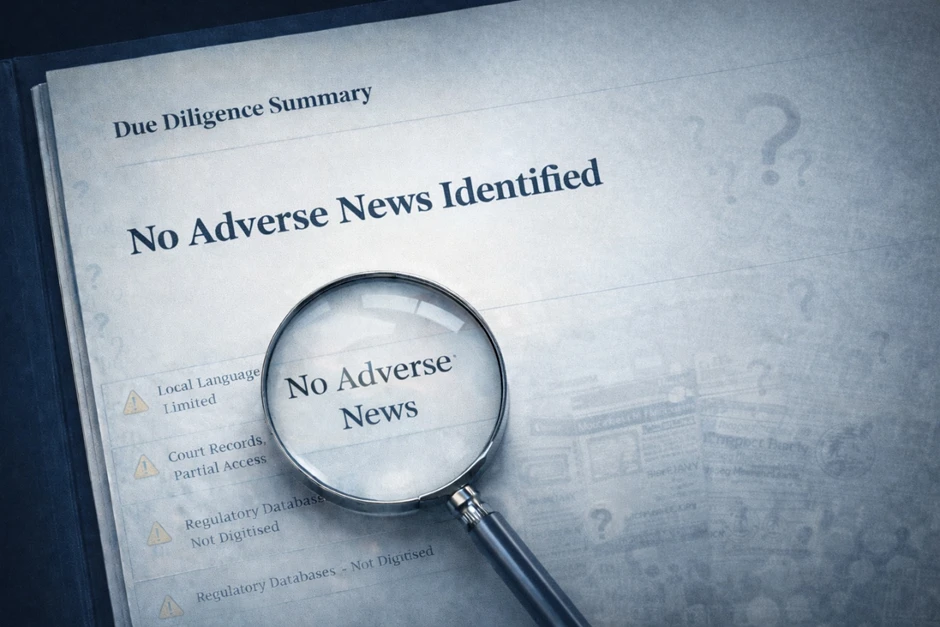

Uncovering hidden assets across Asia Pacific (APAC) requires more than just database access—it demands investigative depth, local cultural context, and a forensic understanding of cross-border corporate gymnastics. Whether for debt recovery, divorce proceedings, or post-judgment enforcement, the trail is rarely linear.
This guide outlines the seven key pillars used by Fullcircle Risk Consulting to identify concealed wealth, illustrated with insights from our recent investigations in India and the wider region.
1. Corporate Registry Searches: Mapping Ownership and Control
Corporate registries are the starting point for uncovering beneficial ownership, identifying related-party networks, and locating undisclosed assets. In Asia Pacific jurisdictions—where company structures often involve layered shareholding and nominee directors—registry searches are essential for establishing a target’s legal and operational footprint.
What we look for:
- Directorship Links: Identifying every entity a subject is associated with.
- Shareholding Shifts: Tracking when assets were moved to related parties (often right before a legal dispute).
- Registered Charges: Determining which assets are already pledged to banks.
In India, the Ministry of Corporate Affairs (MCA) registry is a goldmine for exposing asset diversion strategies and inter-company linkages that shield property ownership.
2. Property and Land Records: Identifying Tangible Asset Holdings
Real estate often represents the largest portion of a target’s “frozen” or hidden wealth. However, in many APAC jurisdictions, land records are fragmented or not fully digitized.
The Fullcircle Approach:
- Triangulation: We cross-reference addresses found in corporate filings with land registry ownership.
- Encumbrance Checks: Identifying mortgages or liens that might affect your ability to recover the asset.
- Physical Verification: In a recent India-based case, we didn’t just trust the paper trail. Our team visited premium office spaces and industrial warehouses to confirm they were active and operational, proving the asset had real, recoverable value.
This dual-method approach—merging document review with physical verification—is essential for accurate real estate asset tracing across APAC.
3. Banking and Financial Intelligence: Following the Money Trail
Banking and financial intelligence is at the heart of asset tracing. For example, tracing payments across offshore entities or uncovering underreported receivables from international clients can reveal recoverable value. This method is particularly useful in debt recovery, fraud investigations, and pre-litigation due diligence.
In APAC, financial records may be spread across domestic and offshore accounts, requiring cross-jurisdictional understanding and access to proprietary databases or open-source tools. The goal is to identify both declared financial accounts and concealed funds that may not appear in public records. These investigations often require access to proprietary financial databases, open-source intelligence (OSINT) tools, and cross-border expertise.
At Fullcircle Risk, we analyze the following documents (where available):
- Bank statements and transaction histories for fund movement patterns
- Trade receivables and commercial invoices linked to revenue streams
- Payment flows across suppliers, clients, and affiliates
- Loan agreements, credit lines, or financial pledges that may involve hidden assets
4. Cross-Border Corporate Structures: Uncovering Indirect Asset Ownership
Complex corporate structures are a common method used to hide or obscure true asset ownership. These structures often involve multiple layers of subsidiaries, joint ventures, and intermediary entities spread across several jurisdictions.
Investigative work includes:
- Mapping corporate ownership networks and cross-border affiliations
- Identifying beneficial owners operating through nominee directors or offshore trusts
- Unwinding holding company hierarchies in locations such as Singapore, Mauritius, British Virgin Islands, and Hong Kong
- Linking financial activity across these entities to locate asset transfers or diversions
In the Asia Pacific, these corporate webs are often designed for both tax efficiency and asset protection, making them difficult to penetrate without region-specific knowledge and tools. Successful asset tracing relies on a legal understanding of how control is exercised indirectly and how assets are shielded through related-party transactions or silent partnerships.
5. Lifestyle and Public Profile Analysis: Matching Wealth to Visibility
When assets are concealed or underreported, lifestyle indicators often expose discrepancies between declared income and actual wealth. Through lifestyle analysis and publicprofile reviews, investigators assess whether a subject’s visible standard of living aligns with their reported financial position.
This process includes examining:
- Social media activity, online profiles, and digital footprints
- Press coverage, business announcements, and public appearances
- Ownership or use of highvalue assets such as luxury vehicles, holiday homes, private aircraft, yachts, and collectible items
- Operational footprints, including office locations, warehouses, and branded facilities not reflected in official filings
When combined with corporate registry data, property records, and financial intelligence, lifestyle analysis provides a powerful means of triangulating asset ownership.
6. Legal Filings and Court Records: Tracing Asset Risk and Disputes
Legal filings and court records are a critical source of intelligence for identifying asset exposure, ownership claims, and recovery risks. Past and ongoing litigation often reveals assets that are otherwise undisclosed, as well as judgments, liens, freezes, or encumbrances that directly affect recoverability.
Through systematic review of civil, commercial, insolvency, and bankruptcy proceedings, investigators can uncover:
- Assets subject to legal claims, attachments, or enforcement actions
- Beneficial ownership details disclosed in pleadings or affidavits
- Undeclared properties, business interests, or receivables referenced in disputes
- Patterns of litigation suggesting asset shielding, debt evasion, or concealed value
Court records may also expose related-party transactions, internal conflicts, or creditor actions that point to where assets have been moved or protected.
7. Collaborative Networks: Leveraging Local Intelligence In case of low profile
In the diverse and complex markets of the Asia Pacific, local knowledge is indispensable for effective asset tracing. Collaborating with in-country investigators, regional legal advisors, and industry-specific experts enables a deeper, more accurate understanding of both assets and the environments in which they operate.
In a recent investigation for an Italian creditor, Fullcircle Risk Consulting worked with local teams in India to confirm operational facilities, corroborate ownership records, and identify inconsistencies between official filings and actual asset usage. These partnerships bridged the gap between public data and field-level verification, reinforcing that cross-border asset recovery depends on both analytical rigor and local expertise.
The Bottom Line: Assets Don’t Disappear; They Just Move
Identifying hidden assets is a game of patience and precision. By combining analytical rigor with on-the-ground expertise, you can move from “no assets found” to a defensible recovery strategy.