
A Client’s Checklist for Understanding Risk When Nothing Negative Appears
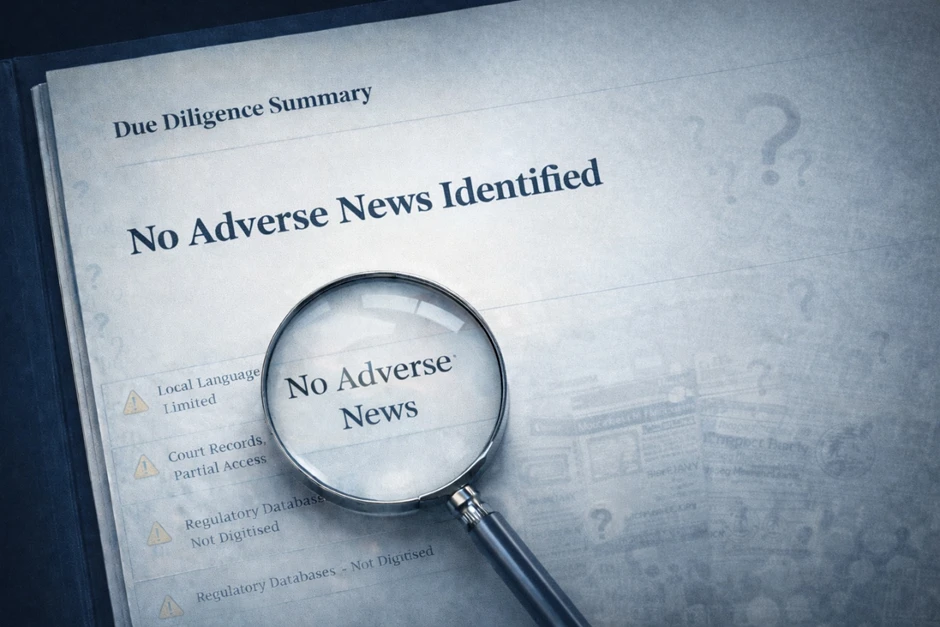
When a due diligence report says “no adverse news”, it can be tempting to assume the subject — whether a vendor, executive, or investment target — is risk-free. But in many high-risk or low-transparency markets, that phrase often reflects limited access to data, not proof of integrity.
Especially in highrisk jurisdictions or low-transparency environments, this outcome may reflect information scarcity rather than genuine absence of risk.
For clients relying on thirdparty risk assessment, corporate intelligence in Asia, or OSINT investigations, it’s crucial to know that the absence of evidence is not evidence of absence. This article explains how to interpret “no adverse news” and avoid overlooking hidden risks.
1. Understand the Limits of Public Data
A conclusion of “no adverse news” only means that no negative findings came up in the sources that were searched — it doesn’t guarantee that adverse information doesn’t exist. Public data varies widely in quality, coverage, and accessibility across countries and sectors.
Ask your investigator:
- Were court and regulatory records included?
Public databases may not index all legal matters, especially in jurisdictions where online access is limited. - Were foreign language resources searched?
Negative information may only be published in local languages or regional outlets. - Were paid or proprietary databases consulted?
Some risks are only visible through subscription tools not available in free searches.
Understanding these limits helps you see “no adverse news” as an incomplete picture rather than a true “green light.”
2. Contextualize by Jurisdiction and Sector
In many Asian jurisdictions, structural constraints suppress public reporting of corruption, litigation, or corporate misconduct. Factors that contribute to information scarcity include:
- The Transparency Gap: If a company is a major employer in a region with weak investigative journalism, local media may be restricted from reporting on its misconduct.
- The “Private” Barrier: Family-owned businesses in the Middle East or India often operate with extreme opacity by design; silence there is a standard operating procedure, not a proof of integrity.
3. Benchmark Against Regional Risk Profiles
A powerful way to interpret silence is to benchmark against their environment:
- The Industry Norm: If competitors in the same sector frequently face regulatory fines or labor disputes, but your target appears “perfectly clean,” the silence itself is a red flag.
- The Visibility Match: Does the lack of media visibility align with the company’s size? If a multi-million dollar firm has zero digital footprint, they may be actively “scrubbing” their online presence.
This helps avoid false comfort when information scarcity is the real issue.
4. Triangulate with “Active” Intelligence
Discovering risk in opaque environments requires supplemental intelligence methods beyond headline news searches. Effective triangulation may include:
- Discreet HUMINT: Conversations with industry contacts often reveal open secrets that have never been printed.
- Regulatory and litigation database checks (including offline and paid sources). Many legal issues are never indexed on public search engines.
- Asset verification and corporate registry searches: These help confirm ownership, operations, and related entities.
- OpenSource Intelligence Digital Forensics: Investigating digital footprints, images, citations, and metadata to uncover patterns.
- Site Verifications: Physically confirming that an office exists and is operational.
5. Moving from Binary to Probabilistic Risk
Instead of a “Yes/No” result, we encourage clients to view “No Adverse News” through the lens of Probability and Risk Tiers.
Due diligence is about forming a riskinformed judgment, not delivering absolute certainty.
Ask whether the findings suggest that adverse issues are:
|
Risk Tier |
Environment |
Interpretation of “No Adverse News” |
|
Low Risk |
Transparent (e.g., Singapore) |
Highly reliable; information is abundant and consistent. |
|
Moderate Risk |
Partially Opaque |
Plausible; some gaps remain. Indirect indicators are needed. |
|
High Risk |
Opaque (e.g., Frontier Markets) |
Likely incomplete; structural constraints make undisclosed issues highly probable. |
Final Thought: The Responsibility of Judgment
When due diligence yields “no adverse news,” the real test is how you respond to what isn’t said. Sound decision-making doesn’t rely on the presence of perfect data—it relies on knowing where data ends and informed judgment begins. At Fullcircle, we don’t just report the news; we explain the silence.