
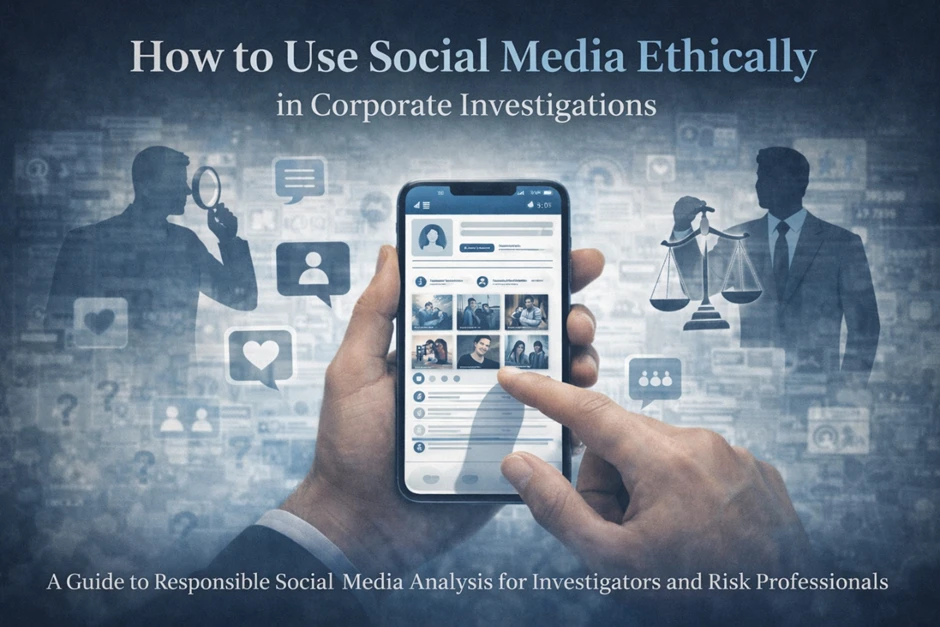
A Guide to Responsible Social Media Analysis for Investigators and Risk Professionals
As social platforms become central to modern life, social media analysis has become a powerful tool in corporate investigations, background checks, and digital due diligence. Public posts, affiliations, and behavioral traces offer context into subjects that might not be visible through official records alone.
Studies on terrorism finance through social platforms show that online activity blends expression, identity performance, and interaction, meaning that individual posts should be assessed in behavioral context, not in isolation.
But with power comes responsibility. While information may be publicly accessible, the method of collection, interpretation, and use matters greatly. In legal and regulatory environments, evidence obtained improperly can undermine credibility or weaken otherwise sound findings.
At Fullcircle Risk Consulting, we use social media analysis ethically and effectively to support decision-making, risk assessments, and compliance investigations across jurisdictions.
|
The Ethics of “Public” Information Ethical social media analysis is the lawful, structured, and context-aware use of digital content. It acknowledges that just because a post is “public” doesn’t mean it is fair game for unregulated use. We focus on behavioral context—recognizing that online activity is often a mix of identity performance and cultural norms. |
5 Best Practices for Ethical Social Media Use in Investigations
1. Verify Sources and Authenticate Profiles
The digital world is rife with “deepfakes,” bot accounts, and impersonations. Before a post is entered into evidence, we must prove:
- Ownership: Does the subject actually control this account?
- Integrity: Has the content been digitally altered or taken out of context?
- Recency: Is this outdated information being “re-surfaced” to create a false narrative?
This prevents false attribution—a major risk when dealing with impersonations, outdated profiles, or automated content.
2. Adherence to Investigative Protocols
Ethical use begins with a “rules of engagement” document. This prevents informal surveillance and ensures every search is:
- Standardized: Every subject is treated with the same procedural rigor.
- Defensible: In the event of a legal challenge, we can show exactly why and how the data was collected.
3. Documenting Findings Carefully
Social media is ephemeral; posts are deleted, and profiles are scrubbed. We ensure every finding is:
- Metadata-rich: Capturing timestamps, original URLs, and source IDs.
- Auditable: Preserving the “chain of custody” for digital evidence so it stands up in court or before a board.
4. Respect the “Need to Know”
Even in a public search, we filter for relevance. We avoid collecting sensitive personal data (such as health information or family photos) that has no bearing on the corporate risk at hand.
- We avoid collecting irrelevant or sensitive personal data
- Refrain from using fake profiles or deceptive methods
- Limit findings to those with a legitimate need to know
5. Prioritize Evidence Over Assumption
Social media can easily invite speculation. Posts may be performative, outdated, or taken out of context. Ethical analysis prioritizes how information aligns with verified facts, instead of assumptions about intent or behavior. With this sort of discipline, your social media insights can support objective analysis instead of subjective interpretation.
Investigators must:
- Avoid drawing conclusions from single posts
- Cross-check content with objective records
- Recognize cultural nuances or behavioral norms in digital expression
This prevents misinterpretation and ensures that social insights support rather than distort the overall investigation.
Why Ethics Matter in OSINT
For the modern investigator, social media is a double-edged sword. Used correctly, it reveals hidden networks and intent. Used incorrectly, it leads to biased conclusions and privacy violations.
At Fullcircle, we bridge the gap between digital data and ethical intelligence.
Need an Ethical Digital Review? Speak with us to see how we can support your next cross-border investigation.