In an era of AI-driven data crawlers and instant digital records, it is tempting to believe the truth is just a few clicks away. But in the Asia-Pacific region—where public registries can be curated and corporate “face” is meticulously maintained—what is public isn’t always what is real.
This is where Human Source Intelligence (HUMINT) becomes your most critical asset. HUMINT isn’t about “spy games”; it is the art of quiet, targeted conversations with those who have direct knowledge of a business: former employees, local advisors, suppliers, and competitors.
These discreet interviews offer the kind of insights that structured data and desktop research simply cannot: context, sentiment, behavioral patterns, and relationship dynamics.
While public records tell you what happened, human intelligence helps explain why.
At Fullcircle Risk Consulting, we often see this come into play when a client needs clarity in low-visibility environments.
The “Polished CEO” Paradox: A Case Study
At Fullcircle Risk Consulting, we recently handled an acquisition of a fast-growing Southeast Asian tech firm. On paper, the target was flawless:
- Public Records: Clean.
- Digital Presence: A polished LinkedIn and glowing media coverage.
- Financials: Showing consistent growth.
However, a lingering question remained: Why did a key co-founder (who was the strongest technically) exit within 24 months? Desktop research couldn’t answer this. Our discreet outreach to former staff revealed a different story: a culture of toxic micromanagement and a CEO at war with the board. Middle management was in a state of “quiet quitting.” These insights—invisible to traditional diligence—completely altered our client’s valuation and negotiation strategy.
When Does “Desktop Research” Hit a Wall?
In jurisdictions where regulatory enforcement is selective or family-owned enterprises dominate, digital records often provide a false sense of security. HUMINT becomes mandatory when:
|
Scenario |
The Limit of Data |
The HUMINT Advantage |
|
Too-Clean Records |
Databases show zero litigation. |
Interviews reveal “off-book” settlements or local intimidation. |
|
Power Dynamics |
Org charts show a clear CEO. |
HUMINT identifies the “shadow director” or hidden beneficiary. |
|
Cultural Red Flags |
Media reports are positive. |
Local sources explain the political or “crony” ties driving that success. |
|
Allegation Testing |
Anonymous tips are unverified. |
Discreet sources can corroborate or debunk whistle-blower claims. |
The HUMINT + OSINT Hybrid
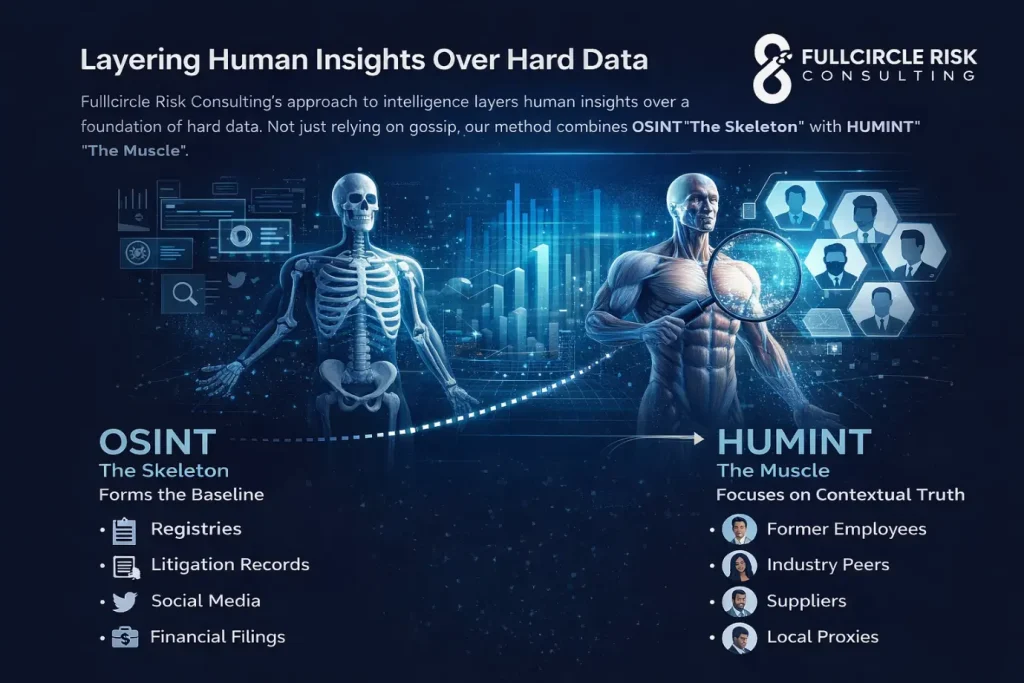
We don’t suggest replacing digital tools; we suggest augmenting them. Real risk intelligence lives at the intersection of documented facts and human sentiment.
- OSINT (Open Source Intelligence): Provides the map (registries, news, filings).
- HUMINT (Human Intelligence): Provides the “feel” for the terrain (reputation, integrity, hidden risks).
|
The Fullcircle Ethical HUMINT Standard While our interviews are “discreet,” they are never “deceptive.” We operate under a strict ethical framework to ensure that the intelligence we gather is both admissible and defensible:
|
If you’re conducting an investigation, making an investment, or onboarding a new partner in a region where transparency isn’t a given, ask yourself this: Who have we actually heard from—directly? Because the truth isn’t always written down. Sometimes, it’s whispered.